Analog Synthesizers Make a Comeback in the Digital Age of Music Production
It is fair to say that digital technology has completely taken over and influenced almost every facet of our functional lives to a large extent. Letters have been replaced by instant messages, emails and video calls, shopping can be done from the comfort of your home at the tap of a button, hassle-free bookings of any required service is now possible without having to physically go somewhere. On that note, the world of music has been no exception.
In this digital age, we have seen acoustic instruments and heavy equipment being replaced by virtual and sample-based instruments. Analog music technology, including signal processors and analog mixing consoles, has evolved into simple plugins and digital audio workstations (DAWs). From working with tape in studios – with all devices existing in physical (hardware) form – to utilizing advanced analog sound synthesis techniques through digital emulations housed within a single laptop-like workstation, digital technology has truly revolutionized music production.

Also, acoustic (real world) instruments are found in the form of virtual instruments, enabling music to be created and processed electronically with greater precision, ease and reliability. This evolution has not only made the music-making process better, but has also helped save precious time, cost and space.
Despite all its benefits and advantages, we are now seeing a massive resurgence of analog music technology in the hardware form of analog sound synthesis, and for good reason.
However, it is first important to understand the meaning of the terms analog and synthesis, before we talk about the reemergence of the same in hardware form.
ANALOG
Analog music technology relies on the fluctuation of current, producing a continuous time signal that represents an actual recreation of its acoustic counterpart or sound wave. Through analog sound synthesis, it creates an instantaneous voltage that mirrors the continuously varying pressure of its corresponding acoustic sound waves.
SYNTHESIS
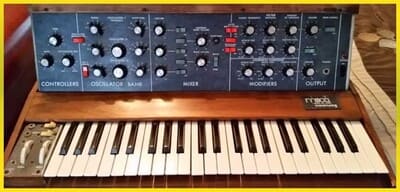
A synthesizer is an electronic musical instrument the works on this very fluctuation of voltage to generate audio signals than can further be processed and mangled to create musical sounds. Synthesizers may imitate traditional instruments such as a piano, violin, flute or even generate sounds such as wind, ocean waves or completely new and novel electronic timbres (sounds with varying character) which are often played with a musical keyboard, or other devices including music sequencers, instrument controllers, or drum like electronic pads. Synthesizers were first used in pop music in the 1960s and are based on various techniques of synthesis (sound wave creation) such as subtractive, additive, wavetable, FM, physical modeling, modular and sample-based synthesis.
With the advent of digital technology, to no exception, emulations of analog synthesizer were also made digitally possible. They are exact digital recreations of some vintage hardware synths and some with new sound possibilities.
However, on the downside, working entirely in the computer lacked the musical feasibility of hands-on control, constant change/movement of knobs-faders and most importantly the characteristics of audio as voltage running through actual circuitry that would modify the still analog current, adding subtle imperfections and humanizing a performance via recording actual performing musicians which is far apart programming notes with a mouse on a computer screen in what inherently feels like an editorial environment given the nature and surgical precision of computers. These subtle imperfections, nuances that gave analog sound its characteristic is exactly what is lacking in an otherwise perfect and error-free digital workstation and software-based music production environment.
Analog Synthesizers Back in Full Steam for Music Production
Taking all the aforementioned points into consideration, there has been a new wave of change in analog music technology that we are witnessing in the music production world now. Some of the most popular synths from the era gone by are now being re-released, re-manufactured, and even modeled by various hardware manufacturers, showcasing the enduring appeal of analog sound synthesis.
Some of the sounds from vintage models of synthesizers are even being digitally recorded and made available as sample packs for usage within a computer-based music production environment. One of the key reasons for doing so is to bring back the sonic characteristic of analog sound that the ears take to very pleasantly. Several synthesizer manufacturers have built their entire reputation based on the sound and character found specific to their make and this resurgence of analog synths will only enhance the sonic palette available to a contemporary electronic music producer or performer.
More and more artists and producers are incorporating analog synthesizers in their projects, recognizing the unique quality of analog music technology. A good sound, especially when achieved through analog sound synthesis, cannot be replaced or processed later to make it any better than its original source. Don’t be surprised if you see a sudden surge in the demand for analog synthesizers in the near future – it is time to embrace this wonderful era!
Check out Seamedu’s courses in sound engineering and music production now!

CATEGORIES
- MBA Program
- Data Science and Analytics
- Cloud Computing
- Data Analytics and Business Intelligence
- AI and Digital Systems
- Cyber Security and Digital Forensics
- Business Analytics & Intelligence
- Banking & Financial Services
- International Business
- Digital Marketing
- Research Paper
- Media & Entertainment
- Media Management
- Journalism and Media Production
- Media & Information Technology
- Visual Communication
- Game Development
- Sound Engineering
- Game Art & Design
- Photography
- Film Making
- Animation & VFX
Are you aspiring to become a proficient Sound Engineering professional?
Look no further; we are committed to nurturing the potential of young minds. Are you ready to enhance your skills?