AI in Animation and VFX: How Artificial Intelligence Is Changing the Creative Industry
AI in Animation and VFX is transforming creative production, from animation and pre-production to visual effects and compositing. Learn how AI is changing the industry, why human creativity still matters, and how aspiring artists can prepare for the future.


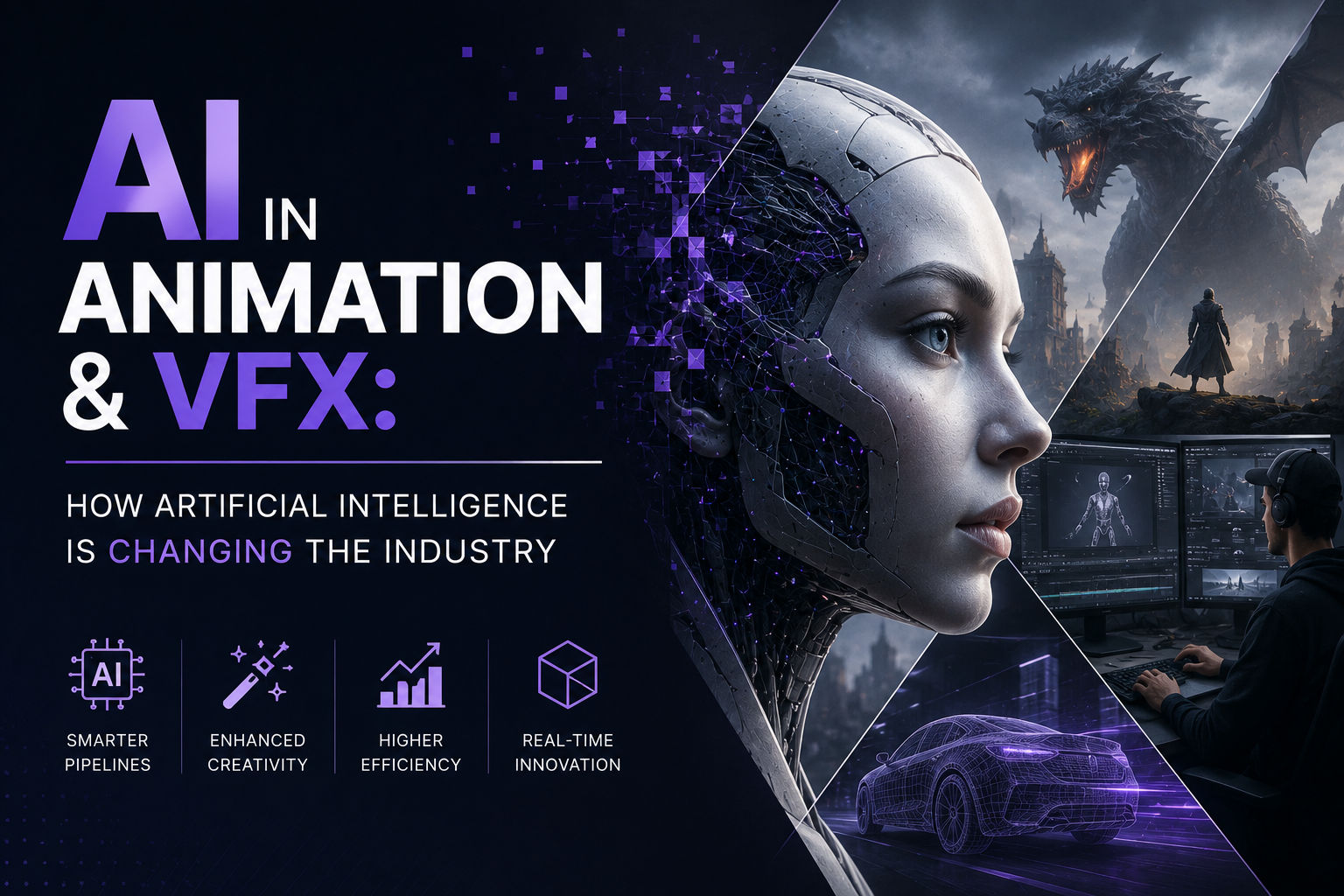
Animation and visual effects have always evolved alongside technology. From traditional hand-drawn animation to 3D modelling, motion capture, digital compositing and virtual production, every technological advancement has changed how artists create visual stories.
Today, Artificial Intelligence is becoming one of the most influential technologies shaping this industry.
But AI in animation and visual effects is about much more than generating an image or creating a video from a text prompt. It is becoming part of the production process itself, helping artists explore ideas, automate repetitive work, test different creative possibilities and work more efficiently.
For anyone considering an Animation and VFX career, understanding this change is becoming increasingly important.
What Is AI in Animation and VFX?
AI in Animation and VFX refers to the use of artificial intelligence and machine-learning technologies to assist with different stages of creative production. These technologies can support everything from concept development and pre-visualisation to animation, compositing, visual effects and post-production.
AI can help generate visual references, assist with character movement, create or modify digital assets, improve footage, isolate objects, assist with rotoscopy and explore different creative directions. Research in generative AI is also moving into areas such as facial animation, gesture generation, motion synthesis, texture creation and character animation.
The important thing to understand is that AI is becoming another tool available to artists. It does not automatically replace the artistic knowledge required to create professional work.
How Is AI Changing Animation?
Animation involves a large number of creative and technical decisions. An animator needs to think about movement, timing, weight, expressions, poses and the personality of a character. AI can now assist with some of these processes, particularly when it comes to generating or refining movement.
AI-assisted animation systems can provide a starting point for character motion based on references or instructions. The animator can then modify and refine the result according to the requirements of the scene.
This makes the role of the animator different, but not necessarily less important.
A generated movement may technically look correct, but that does not mean it communicates the right emotion or personality. Understanding animation principles, acting and storytelling is still essential for creating believable performances.
This is why strong animation fundamentals continue to matter even as AI tools become more advanced.
AI and Faster Pre-Production
Pre-production is one area where AI can make a noticeable difference. Before a scene is produced, artists and filmmakers often need to explore characters, environments, camera angles, lighting and visual styles.
AI allows creative teams to experiment with these ideas quickly. Instead of spending hours developing a polished concept simply to test whether an idea works, artists can explore several directions and decide which one deserves further development.
This can make the creative process more flexible.
For students learning Animation and VFX, understanding how AI can support pre-production can also help them approach projects differently. Rather than using AI simply as a shortcut, they can use it as a tool for visual exploration and creative problem-solving.
AI in Storyboarding and Concept Development
Storytelling remains at the centre of animation and filmmaking. Technology can help create visuals, but the creative intention behind those visuals still comes from people.
AI can assist artists in turning rough ideas into visual references during the early stages of production. A director or concept artist can experiment with different environments, characters, compositions and styles before deciding on a final direction.
This can be especially useful during brainstorming.
However, AI-generated concepts still require human judgement. An artist needs to understand whether a particular composition supports the story, whether the character design fits the world and whether the visual style is appropriate for the project.
AI can help explore possibilities, but the creative decision remains with the artist.
How AI Is Changing VFX
The influence of AI in VFX is equally significant. Traditional visual-effects production can involve complex processes such as tracking, rotoscopy, keying, compositing, cleanup, simulation, lighting and rendering.
Many of these processes require significant time and attention. AI can assist with some repetitive tasks, allowing artists to focus more on the creative and technical decisions that require experience.
One example is rotoscopy. Creating accurate masks around moving subjects has traditionally been a time-consuming process. AI-assisted tools can identify subjects and objects in footage and create a starting point that artists can refine.
This can be particularly useful when working with large amounts of footage.
However, AI-generated masks are not always perfect. Hair, motion blur, transparent objects, complex backgrounds and fast movement can still require careful manual correction.
The technology therefore works best when combined with the judgement of an experienced artist.
AI-Assisted Compositing
Compositing is another area where AI is becoming increasingly useful. VFX artists need to combine multiple elements into a single believable shot while maintaining consistency in lighting, colour, perspective and depth.
AI can assist with certain aspects of image preparation, object isolation, cleanup and enhancement.
This can reduce repetitive work and give artists more time to concentrate on the overall quality of the shot.
A professional compositor still needs to understand why an element looks out of place. They need to recognise differences in lighting, colour, focus, perspective and atmosphere. These are skills that come from understanding visual effects, cinematography and image-making rather than simply knowing how to operate a particular tool.
Will AI Replace Animators and VFX Artists?
This is perhaps the biggest concern among students who are interested in the VFX industry and animation.
The more realistic way to look at it is that AI is likely to change many creative roles rather than simply eliminate them.
Animation and VFX are not purely technical fields. They involve storytelling, emotion, visual communication and creative decision-making.
Imagine an AI system generating a character walking across a room. The movement may look convincing, but does it match the character's personality? Does the timing work with the dialogue? Does the movement communicate the emotion intended by the director?
These decisions still require a human artist.
AI can generate an output, but an experienced artist understands what needs to change and why it needs to change.
That understanding is developed through practice, observation and strong creative fundamentals.
The Future VFX Artist Will Need More Than Software Skills
For many years, aspiring artists focused heavily on learning software. Tools such as Maya, Blender, After Effects, Nuke and other production applications remain important, but the future VFX artist will need a wider skill set.
Strong artistic fundamentals will continue to matter. Understanding composition, colour, lighting, anatomy, movement and visual storytelling gives artists the ability to judge the quality of their work.
Technical knowledge is equally important. Understanding modelling, texturing, rigging, animation, rendering and compositing helps artists understand where their work fits within a production pipeline.
Alongside these skills, AI literacy is becoming increasingly valuable.
Artists need to understand what AI tools can do, where they can save time, where they produce unreliable results and where human intervention is necessary.

CATEGORIES
- MBA Program
- Data Science and Analytics
- Cloud Computing
- Data Analytics and Business Intelligence
- AI and Digital Systems
- Cyber Security and Digital Forensics
- Business Analytics & Intelligence
- Banking & Financial Services
- International Business
- Digital Marketing
- Research Paper
- Media & Entertainment
- Media Management
- Journalism and Media Production
- Media & Information Technology
- Visual Communication
- Game Development
- Sound Engineering
- Game Art & Design
- Photography
- Film Making
- Animation & VFX
Are you aspiring to become a proficient Animation & VFX professional?
Look no further; we are committed to nurturing the potential of young minds. Are you ready to enhance your skills?