Game Art Portfolios in 2026: How to Stand Out in the AI Era.
What makes a game art portfolio convincing in the AI era? Tanmay Datta explains how to present original work, document creative decisions and demonstrate practical skills beyond the final render.


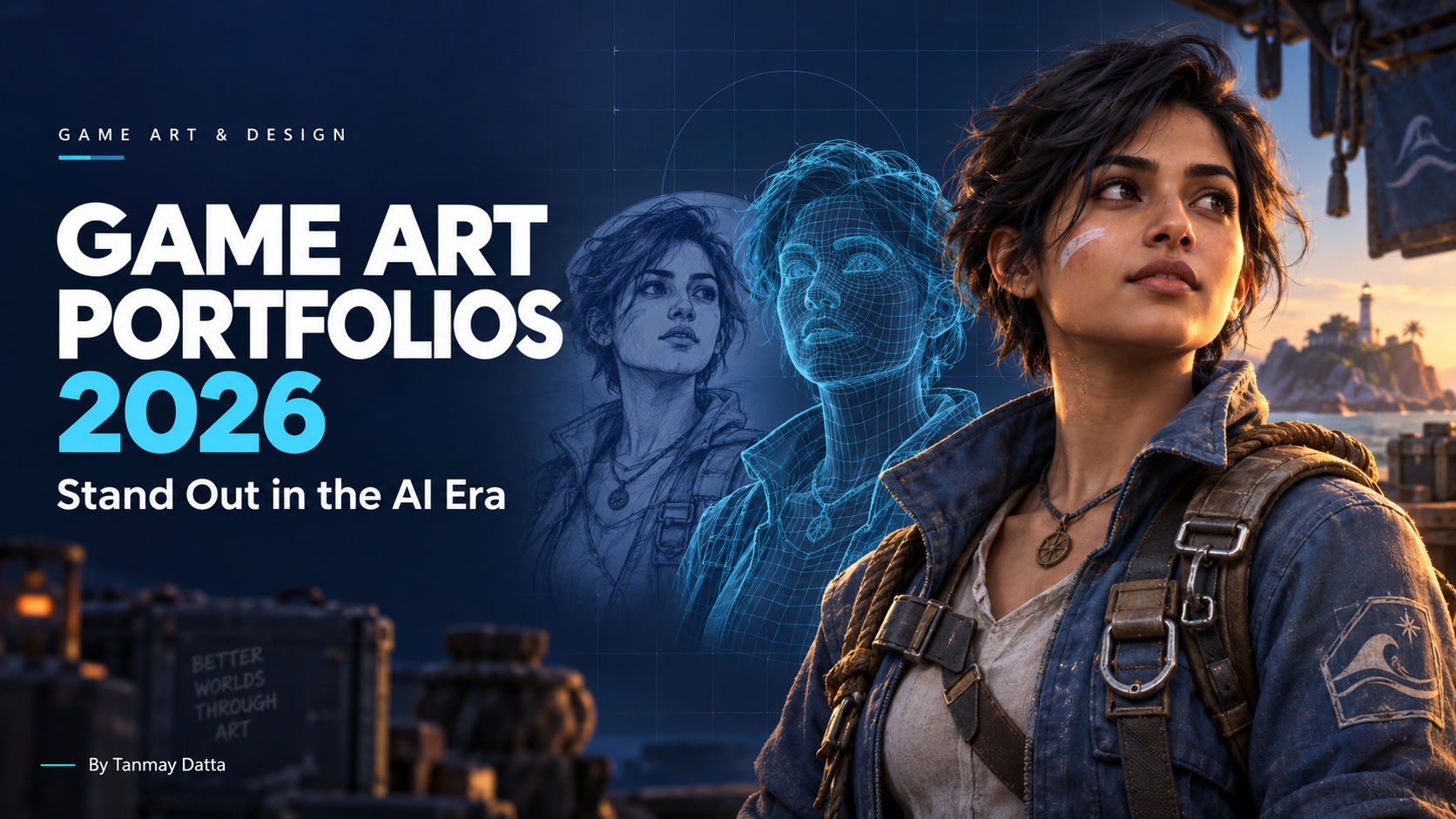
Game Art Portfolios in 2026: How to Stand Out in the AI Era
By Tanmay Datta
You have spent weeks building a character. The sculpt looks good, the textures are finished, and the final render is ready to upload. Then you open your feed and see an AI-generated character image that looks equally polished at first glance.
It is easy to wonder where that leaves your work.
Your project contains things that a single image cannot explain: how you built the model, corrected its proportions, organised the textures and made it work beyond one camera angle. Your portfolio is where those decisions become visible.
For students putting together a game art portfolio in 2026, that is a useful place to start. Give people enough evidence to understand both the finished artwork and your ability to create it.
Why Process Matters in the AI Era
AI is a real concern within the industry. In GDC’s 2026 State of the Game Industry survey, 52% of respondents said generative AI was having a negative impact on the industry. Among respondents working in visual and technical art, the figure was 64%. These are survey findings, not a hiring policy shared by every studio. Source: GDC’s 2026 report.
For an aspiring artist, the practical response is to make your contribution easy to understand. A finished render shows the result. A thoughtful breakdown helps someone assess how you reached it, what you understand and where you still need practice.
That breakdown does not need to document every click. Choose the stages that explain a meaningful decision.
Choose the Role Your Portfolio Should Support
Before selecting projects, decide what kind of work you want to do. A character artist, environment artist and animator need different evidence in their portfolios.
Art directors featured in ArtStation’s portfolio guidance recommend tailoring work to the role, presenting a focused selection and clearly crediting collaborators. Those principles remain a useful starting point. Source: ArtStation’s portfolio advice.
For a character art role, you could show a finished character alongside anatomy studies, topology and material details. For environment art, a small, complete location can demonstrate composition, modular construction and lighting. For animation, movement needs to take centre stage: balance, timing, weight and believable transitions.
If you are still choosing a direction, Seamedu’s guide to Game Art, Game Design and Game Programming explains how these paths differ.
Turn a Finished Project into a Useful Case Study
Imagine creating a game character who repairs machines in a coastal town. Start with the brief. What does the character do? What should a player understand from their silhouette? How would the climate affect their clothing and equipment?
Then show the decisions that followed. Perhaps the first tool bag was too large and hid the hand during an animation test. You reduced it and moved the strap. Perhaps the jacket and trousers looked too similar under the scene lighting, so you adjusted their material response.
Keep captions specific. “Improved the model” says very little. “Simplified the belt geometry after it intersected the jacket during the crouch test” explains a decision.
Show How the Asset Works in a Game
A close-up render is useful, but game assets also need to hold up at the distance and angle from which players will see them.
For a portfolio exercise, place your prop or character in a simple engine scene. Show it under ordinary lighting and at a plausible gameplay distance. Check whether its main shapes still read clearly. If a small surface detail disappears completely, consider whether it needs geometry or could be handled through a texture.
Record relevant technical details, such as triangle count, texture sizes and material slots. Explain the target you set for the project. There is no single polygon budget that suits every game, platform and asset.
If you report performance, include the hardware, resolution and test conditions. A frame-rate number on its own gives the reader little context.
For Animation, Let the Movement Carry the Piece
If your focus is character animation, a simple action can reveal a great deal. A character lifting a heavy bag needs preparation, a convincing shift of weight and a recovery that matches the effort.
Show the motion clearly. A static camera and simple background can make balance and foot contact easier to assess. Include a short progression from blocking to polish when it explains how you developed the performance.
For a game animation exercise, you might show an idle, a walk and the transition between them. Watch for sliding feet, sudden changes in speed and movements that lose their weight when repeated.
Credit the character model and rig if someone else created them. State exactly which parts of the animation are yours, including any motion-capture cleanup.
Be Specific About AI Use
If generative AI contributed to a project, describe its role plainly. “AI-assisted” is too broad to explain whether you used it for early ideas, textures, code or the final image.
A disclosure might read:
“Generative AI was used to explore early colour directions. I created the model, UVs, textures and lighting. The final images are captured from the engine.”
Use wording like this only when it accurately describes your work. If generated material appears in the final asset, identify it. Follow the requirements of the studio, course or competition you are submitting to.
Also keep your presentation faithful to the asset. If an image tool adds details that do not exist in your model, the edited image cannot reliably demonstrate the model’s quality. Keep any such exploration separate from the images used to assess your 3D work.
Build a Project You Can Observe Closely
When you need a fresh portfolio idea, look at places and objects you know. A repair shop, a weathered railway bench or a neighbourhood tea stall can offer plenty to study.
For a tea-stall environment, think about where the owner stands, how supplies are stored and which surfaces are touched most often. Those observations can guide layout, wear and storytelling. Collect your own reference photographs where permitted, then develop a clear visual brief.
Keep the scope manageable. Begin with a counter, a kettle, a few glasses and the surrounding wall. Finish that small scene, test it and document it before expanding the location.
Your next portfolio improvement may already be sitting in an unfinished project folder. Open one piece, identify the weakest part and give it a proper revision. Then show what changed. That is a concrete way to demonstrate the judgement and care you would bring to the next assignment.
To explore the field further, visit Seamedu’s Game Art & Design resources and consider which specialisation you want your next project to support.
About the Author
Tanmay Datta has over five years of combined experience in 3D Animation, VFX and teaching. He graduated from George Brown College, Toronto, in Game Development, specialising in Character Animation. He began his career as a stereo artist at Legend 3D, later working in compositing and VFX on films including Avengers, Thor, Passengers and X-Men: Apocalypse.
After two years and six months of industry experience, Tanmay moved into tutoring and mentoring. He also has three years of experience teaching 3D Animation and VFX, bringing his passion for animation into his work with students.
CATEGORIES
- MBA Program
- Data Science and Analytics
- Cloud Computing
- Data Analytics and Business Intelligence
- AI and Digital Systems
- Cyber Security and Digital Forensics
- Business Analytics & Intelligence
- Banking & Financial Services
- International Business
- Digital Marketing
- Research Paper
- Media & Entertainment
- Media Management
- Journalism and Media Production
- Media & Information Technology
- Visual Communication
- Game Development
- Sound Engineering
- Game Art & Design
- Photography
- Film Making
- Animation & VFX
Are you aspiring to become a proficient Game Art & Design professional?
Look no further; we are committed to nurturing the potential of young minds. Are you ready to enhance your skills?