How Educational Institutions Can Create Stronger Industry and Community Impact
The gap between classroom learning and industry expectations is one of the biggest concerns students and parents have today. This article explores concrete ways educational institutions — especially those in creative and media fields — can move beyond theory and build real, lasting impact across industries and communities. Seamedu's approach is used as a working example throughout.

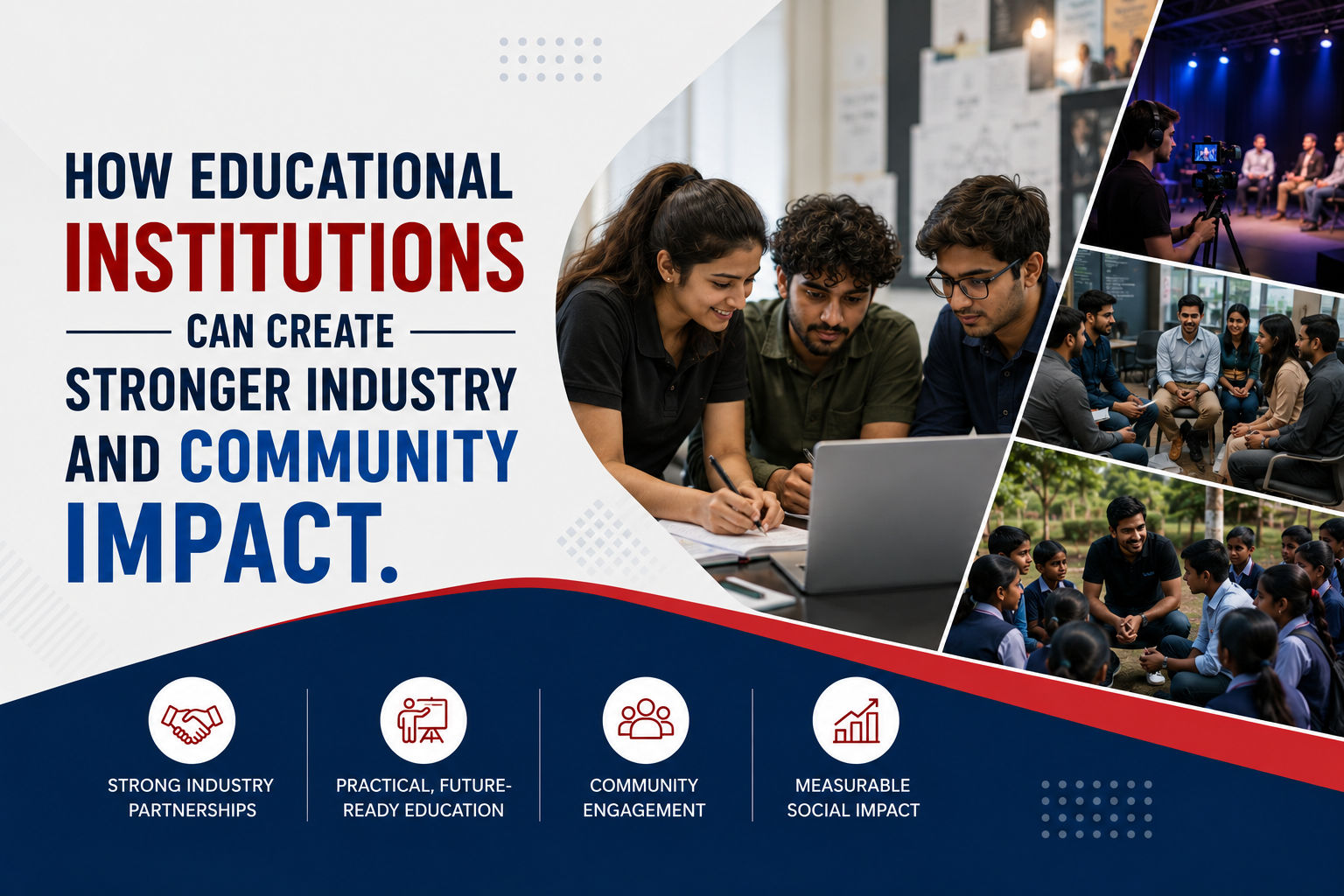
How Educational Institutions Can Create Stronger Industry and Community Impact
Every year, thousands of graduates walk out of college gates carrying degrees that look impressive on paper — only to spend months figuring out why real workplaces feel so foreign. This isn't a personal failure. It's a systemic one. The institutions that produced them stayed busy teaching syllabus, not skills; theory, not practical; classrooms, not careers.
That gap is closing, but slowly. The colleges making real progress aren't just updating their curriculum — they're rethinking what a college is supposed to be. They're treating industry not as an occasional guest lecturer but as a permanent partner. They're treating communities not as charity projects but as real stakeholders in education.
This article is for anyone thinking seriously about that shift — students choosing colleges, educators trying to evolve their institutions, or industry professionals wondering how to engage meaningfully with academia. We'll also look at how Seamedu School of Pro-Expressionism — one of India's leading media and technology colleges — has been building this model over the years.
1. Why the Traditional College Model Falls Short
Let's be direct: most colleges are still running a 20th-century playbook. Lectures, exams, grades, graduation. Repeat. The problem isn't the people — there are passionate faculty and hardworking students everywhere. The problem is structure.
Industry moves fast. Technologies evolve, roles merge, and entirely new job titles appear every few years. A college course takes 12–18 months to revise. That lag is real, and students pay for it when they step into interviews.
But here's what's interesting — industries aren't waiting for colleges to catch up anymore. Companies are building their own academies, partnering directly with select institutions, or simply preferring candidates with portfolio experience over those with perfect GPAs. The signal is clear: demonstrated skill matters more than certified knowledge.
For colleges to remain relevant, they need to do more than patch their syllabi. They need to rebuild the relationship between education and the real world entirely.
2. What "Industry Impact" Actually Means for a College
The phrase gets thrown around a lot. But impact isn't a press release or an MoU signing ceremony. It shows up in very specific, measurable ways:
Students who graduate knowing how to walk into a professional environment and contribute from day one
Industry professionals who genuinely value the talent pipeline a college produces
Projects, products, or creative work that comes out of the campus and enters the real world
Research or innovation that solves industry problems — not just academic ones
Alumni who stay connected to their alma mater because it still adds professional value to them
None of this happens by accident. It requires deliberate institution-building, not just good intentions.
3. Industry Partnerships: Moving Beyond the Guest Lecture
Ask most colleges about their industry connections and they'll mention their guest lectures. That's a start — but barely. A visiting professional spends 90 minutes talking about their journey, answers a few questions, and leaves. Students get inspiration; they rarely get skill.
Genuine industry partnerships look different. They mean companies co-designing curriculum, so what's taught actually maps to what's needed. They mean live briefs — students solving real problems for real companies, not hypothetical case studies. They mean internships with actual mentorship, not just administrative experience.
What This Looks Like in Creative Education
In fields like film, sound, animation, and media production, the studio and the classroom need to blur. Seamedu's film production programs don't treat professional equipment as a graduation gift — students work with industry-standard tools from semester one. More importantly, they work on productions that go beyond assignments: student films, branded content projects, and collaborative productions that have a life outside the campus.
Similarly, sound engineering students at Seamedu work in professional-grade studios and often collaborate on real recording projects. That's not a perk — it's the curriculum.
The principle here is simple: if your students' work could exist in the real world, it should. If it can only exist as an assignment, something is off.
4. Community Impact: The Underrated Dimension of Institutional Value
Industry connect gets a lot of attention in education circles. Community impact gets far less — and that's a mistake.
An educational institution doesn't exist in a vacuum. It exists in a city, a neighbourhood, a social and cultural ecosystem. When colleges engage meaningfully with that ecosystem, something interesting happens: students learn things no classroom can teach, and communities receive resources they'd otherwise never have access to.
Practical Ways Colleges Create Community Impact
Running skill-building workshops in local communities — not as charity, but as a practical extension of what students are already learning
Creating affordable or free creative services (photography, video production, graphic design) for NGOs, local businesses, or civic bodies
Hosting open events — film screenings, music showcases, design exhibitions — that bring the campus to the public
Partnering with schools in underserved areas to introduce students to creative and technology careers early
Involving community members in student projects as participants, collaborators, or audiences
For students in journalism and media programs, community engagement is especially powerful. Reporting on local issues, documenting community stories, or producing public interest content — these aren't just academic exercises. They build the instincts and ethics that define good journalists.
5. Experiential Learning: The Engine Behind Real Impact
You can talk about industry connect and community engagement as much as you want. But the actual mechanism that makes both work is experiential learning — putting students in situations where they have to figure things out, fail, adjust, and figure them out again.
Experiential learning isn't just about labs or studios, though those matter. It's about how education is designed. Are students solving open-ended problems or just answering set questions? Are they working in teams across disciplines or always in their own lane? Are they presenting their work to external audiences or just their professors?

CATEGORIES
- MBA Program
- Data Science and Analytics
- Cloud Computing
- Data Analytics and Business Intelligence
- AI and Digital Systems
- Cyber Security and Digital Forensics
- Business Analytics & Intelligence
- Banking & Financial Services
- International Business
- Digital Marketing
- Research Paper
- Media & Entertainment
- Media Management
- Journalism and Media Production
- Media & Information Technology
- Visual Communication
- Game Development
- Sound Engineering
- Game Art & Design
- Photography
- Film Making
- Animation & VFX
Are you aspiring to become a proficient Media & Entertainment professional?
Look no further; we are committed to nurturing the potential of young minds. Are you ready to enhance your skills?